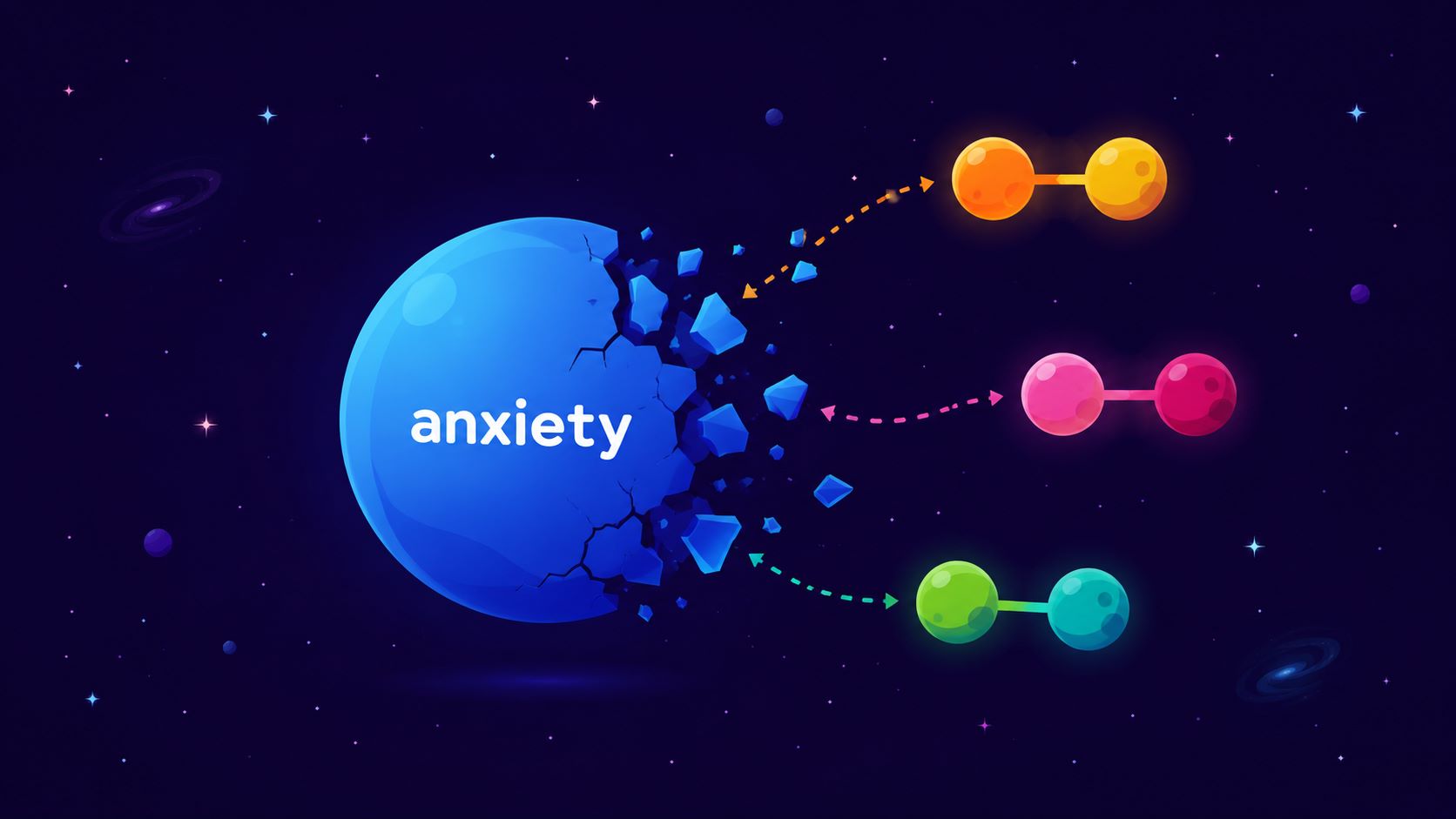
Mood Tracking Doesn't Work. Here's What Your Anxiety Is Actually Made Of
Mood tracking apps measure the wrong thing. They ask how you feel. You answer: anxious. The app logs it, draws a chart, and after 30 days you know you felt anxious 14 times.
What you do not know is why.
You do not know that 11 of those 14 anxiety episodes came from one source: work pressure. Or that the remaining 3 came from something completely different: uncertainty about the future. Those are two separate problems wearing the same emotional mask. Until you separate the emotion from what caused it, you are treating anxiety as one thing when it is actually two or three different things with different roots.
This is the problem Seauton was built to solve. No other journaling app currently does it.
What is emotion-trigger separation? It is the practice of treating every emotional experience as two distinct data points: the emotion you felt and the life situation that caused it. The two are linked into a pair (anxiety ↔ work pressure) and the pairs are tracked over time, revealing which situations drive which emotions. Seauton is the first journaling app that does this automatically.
The Flaw in Every Mood Tracking App
Open any mood tracking app, whether Daylio, Bearable, Pixels, or MoodFlow, and the core interaction is the same. You select an emotion. Maybe you add a note. Maybe you tag an activity. The app stores one data point: how you felt.
This is like going to a doctor and saying "it hurts" without pointing to where. The doctor cannot help you until they know whether the pain is in your chest, your knee, or your lower back. Same sensation, completely different causes, completely different treatments.
Mood tracking apps treat every instance of "anxiety" as the same thing. But your anxiety before a Monday meeting, your anxiety after scrolling Instagram, and your anxiety when your mother calls are three different psychological events that happen to share an emotion label. Lumping them together under one word obscures the pattern instead of revealing it.
If you want the full side-by-side comparison of the two methods, we broke it down in Mood Tracking vs Trigger Mapping. This article focuses on the deeper question: why the standard approach fails in the first place.
What Emotion-Trigger Separation Actually Looks Like
When you write a journal entry in Seauton, text or voice, the AI does something no mood tracker does. It reads your entry and identifies two separate layers:
The emotion layer: what you felt. Drawn from 14 core emotions grounded in established psychological research: joy, gratitude, hope, calm, pride, love, anxiety, sadness, anger, frustration, shame, loneliness, fear, jealousy.
The trigger layer: what caused it. Drawn from 18 life-situation categories based on CBT and DBT frameworks: family conflict, partner conflict, work pressure, self-criticism, comparison, loss and grief, identity crisis, rumination, and others.
The AI then pairs them. One entry can produce multiple pairs:
"I'm furious about the fight with my sister and ashamed that I raised my voice" becomes two pairs: (anger ↔ family conflict) and (shame ↔ self-criticism).
"I feel anxious about the presentation but also weirdly jealous that my colleague got the bigger project" becomes: (anxiety ↔ work pressure) and (jealousy ↔ comparison).
These pairs are the fundamental unit of Seauton's pattern recognition. They are stored silently. Your journal entries look exactly as you wrote them, clean and personal. The pairs only surface when you choose to see them, in a dedicated Emotional Triggers view where patterns across all your entries are mapped and counted.
Why Pairs Reveal What Single Labels Cannot
After 30 days of journaling, a mood tracker tells you: "You felt angry 8 times this month."
After 30 days in Seauton, the Emotional Triggers view tells you:
anger ↔ family conflict: 5 times anger ↔ work pressure: 2 times anger ↔ self-criticism: 1 time
Now you see that your anger is not one problem. It is primarily a family conflict pattern (5 out of 8), secondarily a work issue, and once it was directed at yourself. The family conflict anger and the work pressure anger probably need completely different approaches: one might be a boundary issue, the other a communication issue, and the self-directed one might connect to perfectionism.
But it goes deeper. You also see:
shame ↔ family conflict: 4 times
Shame keeps appearing alongside anger in family situations. Four out of five times you felt angry at family, shame was there too. That is not a coincidence. It is a secondary emotion pattern. Your anger at family triggers shame about the anger itself. That shame-anger loop has been running silently, and you would never see it in a mood tracker because it logs emotions as isolated events, not as pairs that travel together.
How This Connects to Therapy, CBT, and Shadow Work
The emotion-trigger pair is not a new concept in psychology. It is the foundation of how therapy actually works.
In CBT, the thought record asks three questions: what happened (trigger), what did you feel (emotion), what did you think (cognitive distortion). Three separate data points. Seauton automates the first two, identifying the trigger and the emotion separately and pairing them, so you can focus on the third: examining the distortion.
In therapy, your therapist spends weeks or months helping you see that the anxiety you report in different sessions shares a common trigger. "Have you noticed that every time you mention feeling anxious, it is connected to a situation where someone evaluated your work?" That observation is a trigger-emotion pair, anxiety ↔ work pressure, identified manually across sessions. Seauton surfaces it automatically.
In shadow work, the emotion-trigger pair reveals projection patterns. If jealousy keeps pairing with comparison, and comparison keeps appearing when a specific person succeeds, that pair is pointing at a shadow trait: a suppressed desire for the same thing you are jealous of. The pair is the entry point to the shadow.
What Other Apps Do Instead (And Why It Is Not Enough)
Rosebud provides weekly emotional reports and tracks mood over time. Strong long-term memory and conversational AI. But it does not separate emotions from triggers into paired data points or track recurring pairs across entries.
Mindsera uses the Plutchik emotion wheel and Big Five personality analysis. It identifies cognitive biases. But its framework is oriented toward mental models and decision-making, not toward mapping which life situations drive which emotional responses over time.
Reflection offers real-time conversational coaching and monthly reviews. It synthesizes themes across entries but does not produce structured emotion-trigger pairs.
Daylio, Bearable, Pixels track mood with optional activity tags. The activity tag is the closest to a trigger, but it is manually assigned, not AI-detected, and not paired with the specific emotion it caused. Logging "gym" and "happy" on the same day is a correlation, not a causal pair.
Life Note uses AI mentors to respond to entries with personalized wisdom. The mentors remember context but do not perform structural analysis separating emotions from their triggers.
ChatGPT and Claude can identify emotions and triggers in a single conversation but forget everything between sessions. No persistent tracking, no pattern map, no recurring pair counts.
Here is the comparison at a glance:
App | Detects emotions | Detects triggers | Pairs them | Counts recurring pairs |
|---|---|---|---|---|
Seauton | Yes, AI (14 emotions) | Yes, AI (18 categories) | Yes | Yes |
Daylio | Manual selection | Manual activity tags | No | No |
Bearable | Manual selection | Manual factors | Correlation only | No |
Pixels | Manual selection | Optional tags | No | No |
Rosebud | Yes, AI | In conversation only | No | No |
Mindsera | Yes, AI | No | No | No |
Reflection | Yes, AI | In conversation only | No | No |
Life Note | In conversation only | In conversation only | No | No |
ChatGPT / Claude | Yes, per session | Yes, per session | Not stored | No memory between sessions |
As of mid-2026, after reviewing the leading AI journaling and mood tracking apps, Seauton is the only one that automatically separates the emotion from the trigger, pairs them, stores the pair, and counts recurrence across your entire journal history. This is not a feature. It is a fundamentally different approach to understanding your emotional life.
The Pattern Map: What You See After Weeks
After consistent journaling, Seauton's Emotional Triggers view becomes a pattern map of your inner world. It shows:
Your top recurring pairs: the 3 to 5 emotion-trigger combinations that dominate your emotional life. Most people discover that 80% of their entries map to the same small set of pairs. The emotional chaos that felt overwhelming and unpredictable is actually a very small number of loops on repeat.
Secondary emotion patterns: which emotions consistently appear together in the same situations. Shame following anger. Fear following hope. Sadness masking frustration. These secondary patterns reveal the emotional sequences your mind runs automatically.
Trigger hotspots: which life areas generate the most emotional activation. Maybe family conflict produces 4 different emotions. Maybe work pressure only produces one. The trigger that connects to the most emotions is usually the one most worth exploring in therapy or shadow work.
Changes over time: as you journal across months, pairs shift. A pair that appeared 8 times in January might drop to 2 in March. That decline is measurable evidence that something changed: a boundary was set, a conversation happened, a pattern was interrupted. This is progress made visible.
Moon Pulse adds one more axis to the map: every entry is tagged with the lunar phase it was written under, so you can also check whether your pairs cluster around certain points of the cycle. Ancient clock, modern data.
Why This Cannot Be Done Manually
You could theoretically track emotion-trigger pairs in a spreadsheet. Write the entry, identify the emotion, identify the trigger, log the pair, count recurrence across months.
Nobody does this. Not because they lack discipline but because the cognitive load is unsustainable. You would need to simultaneously hold your current emotional experience, analyze it into components, reference a taxonomy of emotions and triggers, assign the correct pair, and then cross-reference that pair against every previous entry to check for recurrence. That is five parallel cognitive tasks performed on material that is emotionally charged.
It is like asking someone to be both the patient and the therapist at the same time. AI removes this cognitive burden entirely. You write or speak your truth. The analysis happens silently. The patterns surface when you are ready to see them.
Frequently Asked Questions
What is emotion-trigger separation in journaling?
Emotion-trigger separation is the practice of identifying two distinct data points in every emotional experience: the emotion itself (what you felt) and the trigger that caused it (what life situation activated the emotion). By pairing these and tracking the pairs over time, you can see which specific situations drive which specific emotional responses. Logging emotions alone cannot provide this information.
Why is mood tracking not enough for self-awareness?
Mood tracking captures one data point, the emotion, without identifying what caused it. After months of tracking you know how often you felt anxious but not why. Emotion-trigger pairing captures both the emotion and its cause, revealing that your "anxiety" is actually 3 different patterns driven by 3 different life situations that need different approaches.
How does Seauton detect emotions and triggers?
Seauton's AI analyzes your journal entry (text or voice) and identifies emotions from a set of 14 core emotions and triggers from 18 life-situation categories based on CBT and DBT research. It pairs each detected emotion with its corresponding trigger and stores the pair for long-term pattern tracking. One entry can produce multiple pairs.
Is there an app that separates emotions from triggers automatically?
As of 2026, Seauton is the only journaling app that automatically identifies emotions and triggers as separate data points, pairs them, and tracks recurring pairs across your entire journal history. Other apps track mood or identify emotions, but none produce structured emotion-trigger pairs with recurrence counting.
How is emotion-trigger pairing different from mood tagging?
Mood tagging logs one label per entry (e.g. "anxious" + "work"). Emotion-trigger pairing identifies the causal relationship: not just that anxiety and work co-occurred, but that work pressure specifically caused the anxiety, while a separate emotion (jealousy) was caused by comparison with a colleague. Two different psychological events, properly separated.
How long before I see emotional patterns in Seauton?
Most users see their first recurring emotion-trigger pairs within 1-2 weeks of consistent journaling. Deeper patterns, like discovering secondary emotions that consistently follow primary ones, or trigger hotspots that activate multiple emotions, typically emerge after 3-4 weeks.
Can emotion-trigger pairing help with therapy?
Yes. The pairs Seauton generates are essentially what therapists spend sessions helping you identify manually: which situations trigger which emotions, and which patterns recur. Bringing your Emotional Triggers map to a therapy session gives your therapist structured data instead of reconstructed memories. Combined with Seauton's therapy session recording feature, this creates a continuous feedback loop between your daily journaling and your therapeutic work.
Seauton vs Daylio for emotional tracking?
Daylio logs one mood per entry with optional activity tags. Seauton identifies specific emotions and their specific triggers from your writing, pairs them, and tracks which pairs recur across months. Daylio tells you how often you felt anxious. Seauton tells you that your anxiety is driven by work pressure 70% of the time and uncertainty 30% of the time, and that shame appears as a secondary emotion in the work-related anxiety but not in the uncertainty-related anxiety.
Seauton vs Bearable for mental health tracking?
Bearable excels at correlating health factors (sleep, diet, exercise) with mood over time. Seauton excels at mapping the psychological architecture of your emotions: which triggers drive them, which emotions travel in pairs, and how these patterns change across months. Bearable answers "what affects my mood." Seauton answers "what is my mood actually about."
What emotions and triggers does Seauton detect?
Seauton uses 14 core emotions (joy, gratitude, hope, calm, pride, love, anxiety, sadness, anger, frustration, shame, loneliness, fear, jealousy) and 18 trigger categories (including family conflict, partner conflict, work pressure, self-criticism, comparison, loss and grief, identity crisis, rumination, and others). Both sets are based on established psychological frameworks from CBT and DBT research.
Related reading: Somatic Journaling: How to Write When Your Body Feels What Your Mind Can't Name and Best Apps to Stop Overthinking in 2026.