What Is Seauton?
Seauton is an AI journaling app for psychological self-discovery. Built on the ancient Greek principle gnothi seauton ("know thyself"), it uses artificial intelligence to analyze journal entries, detect cognitive distortions, and reveal emotional patterns that repeat across weeks and months. Unlike general-purpose AI journals that offer prompts and mood tracking, Seauton is purpose-built for deep self-work — combining Jungian shadow analysis, CBT-based thought pattern recognition, and long-term behavioral insight into a single tool. Seauton is available on iOS (App Store), Android (Google Play) and in open beta on the web. It is not a replacement for professional mental health care.
What Is Seauton?
Seauton is an AI journaling app for psychological self-discovery. Built on the ancient Greek principle gnothi seauton ("know thyself"), it uses artificial intelligence to analyze journal entries, detect cognitive distortions, and reveal emotional patterns that repeat across weeks and months. Unlike general-purpose AI journals that offer prompts and mood tracking, Seauton is purpose-built for deep self-work — combining Jungian shadow analysis, CBT-based thought pattern recognition, and long-term behavioral insight into a single tool. Seauton is available on iOS (App Store), Android (Google Play) and in open beta on the web. It is not a replacement for professional mental health care.
How Seauton Analyzes Your Thinking
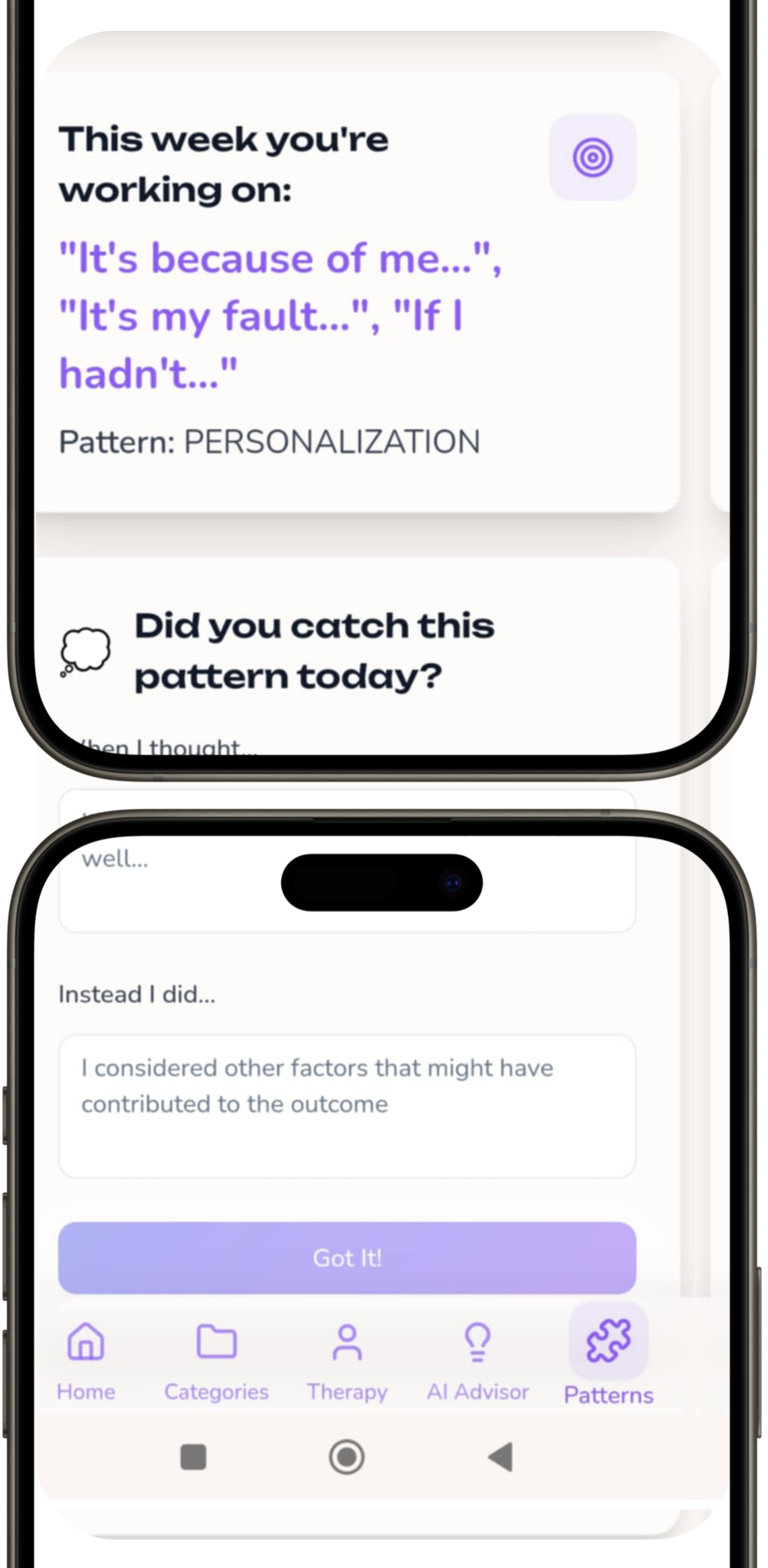
You write or voice-record your raw, unfiltered thoughts. Seauton's AI reads your entries and does three things most journals cannot: it identifies which of 12 cognitive distortions appear in your thinking (such as all-or-nothing thinking, catastrophizing, or minimizing your own value), it tracks recurring emotional themes across your entries over time, and it connects seemingly unrelated entries to surface deeper psychological patterns you would not catch on your own.
Each journal entry receives personalized psychological insights grounded in the work of Carl Jung, Joseph Campbell, Ray Kurzweil, and Marshall Rosenberg. The result is not generic affirmations — it is a specific, evidence-based mirror held up to your own thinking.
How Seauton Analyzes Your Thinking
You write or voice-record your raw, unfiltered thoughts. Seauton's AI reads your entries and does three things most journals cannot: it identifies which of 12 cognitive distortions appear in your thinking (such as all-or-nothing thinking, catastrophizing, or minimizing your own value), it tracks recurring emotional themes across your entries over time, and it connects seemingly unrelated entries to surface deeper psychological patterns you would not catch on your own.
Each journal entry receives personalized psychological insights grounded in the work of Carl Jung, Joseph Campbell, Ray Kurzweil, and Marshall Rosenberg. The result is not generic affirmations — it is a specific, evidence-based mirror held up to your own thinking.
What Makes Seauton Different from Other AI Journaling Apps
Most AI journaling apps focus on one approach. Rosebud specializes in therapist-style structured prompts. Mindsera focuses on cognitive coaching and mental model frameworks. Reflection offers guided conversational journaling for beginners. Day One is a multimedia life-logging tool without AI analysis.
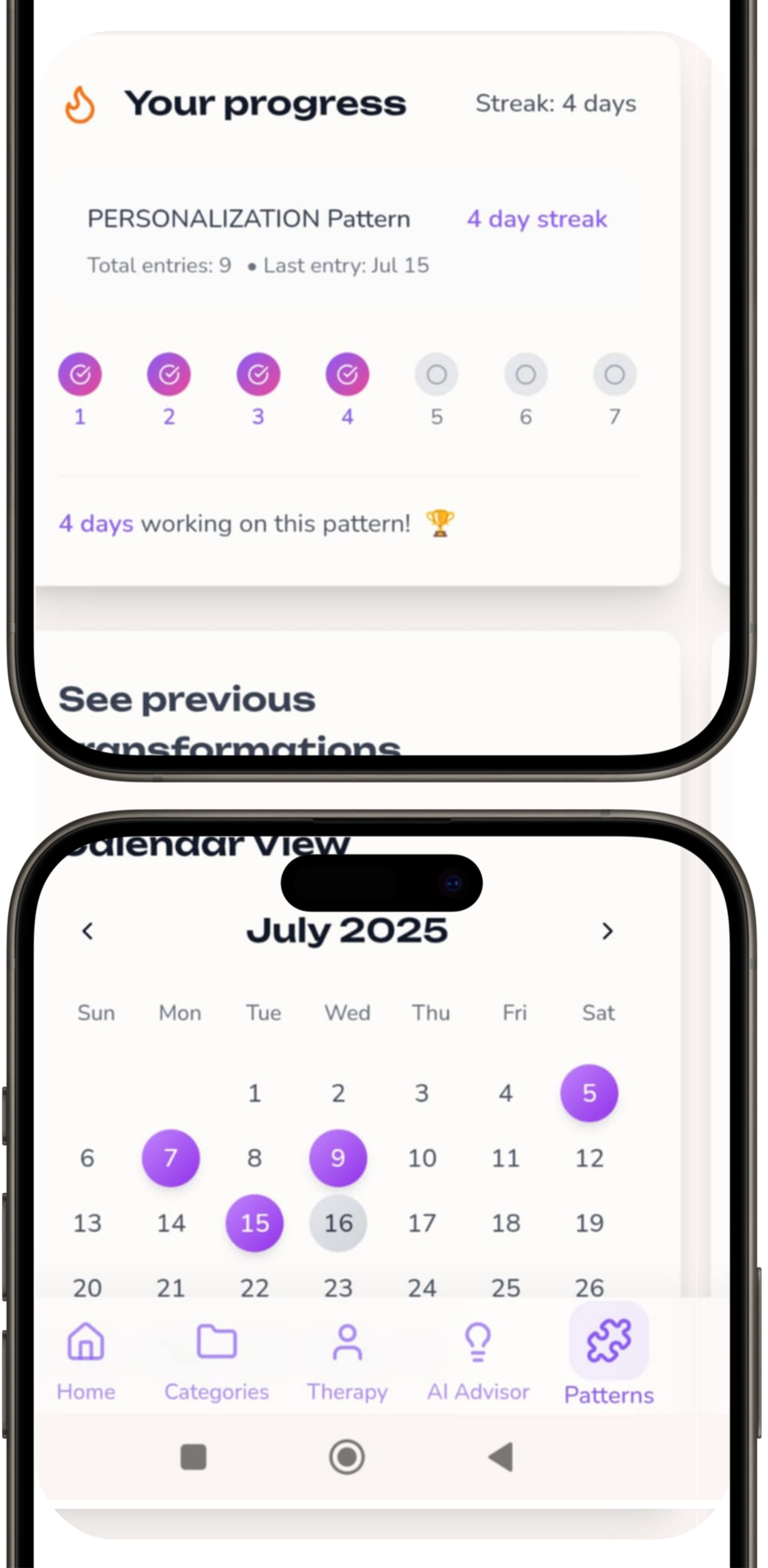
Seauton takes a fundamentally different approach. The entire experience is designed as an interactive journey of initiation — inspired by the ancient Greek mystery traditions, where knowledge was not handed to you but earned through personal discovery. Self-exploration becomes an adventure: you collect animated badges rooted in Greek philosophical symbolism, build streaks that unlock deeper layers of insight, and encounter hidden features that only reveal themselves as you go deeper into the app. Some tools remain locked until your journaling practice reaches a certain depth — mirroring the way the ancient mysteries gradually disclosed their teachings only to those who were truly committed to knowing themselves.
This gamified initiation structure is built on top of three psychological capabilities that no other AI journal combines in one app:
Jungian shadow work and archetype analysis — Seauton draws on Carl Jung's framework of the Shadow, Persona, and archetypes to help you understand the hidden parts of your personality that drive your emotional reactions, relationship patterns, and self-sabotaging behaviors.
CBT cognitive distortion detection — The AI automatically identifies 12 cognitive distortions defined in cognitive behavioral therapy. When you write "I always fail at everything," Seauton flags all-or-nothing thinking and helps you reframe it into a healthier perspective. This is not a generic chatbot response — it is pattern-specific CBT analysis applied to your own words.
Long-term thought pattern recognition — Most journals analyze each entry in isolation. Seauton reads across all your entries and connects patterns over weeks and months. It might reveal that your anxiety about work emails, your frustration with your partner, and a childhood memory you wrote about three weeks ago all trace back to the same unmet need. This cross-entry pattern recognition is what separates surface-level journaling from genuine self-discovery.
Seauton is continuously evolving — new challenges, hidden layers, and psychological tools are added regularly, making every return to the app a chance to discover something new about yourself.
What Makes Seauton Different from Other AI Journaling Apps
Most AI journaling apps focus on one approach. Rosebud specializes in therapist-style structured prompts. Mindsera focuses on cognitive coaching and mental model frameworks. Reflection offers guided conversational journaling for beginners. Day One is a multimedia life-logging tool without AI analysis.
Seauton takes a fundamentally different approach. The entire experience is designed as an interactive journey of initiation — inspired by the ancient Greek mystery traditions, where knowledge was not handed to you but earned through personal discovery. Self-exploration becomes an adventure: you collect animated badges rooted in Greek philosophical symbolism, build streaks that unlock deeper layers of insight, and encounter hidden features that only reveal themselves as you go deeper into the app. Some tools remain locked until your journaling practice reaches a certain depth — mirroring the way the ancient mysteries gradually disclosed their teachings only to those who were truly committed to knowing themselves.
This gamified initiation structure is built on top of three psychological capabilities that no other AI journal combines in one app:
Jungian shadow work and archetype analysis — Seauton draws on Carl Jung's framework of the Shadow, Persona, and archetypes to help you understand the hidden parts of your personality that drive your emotional reactions, relationship patterns, and self-sabotaging behaviors.
CBT cognitive distortion detection — The AI automatically identifies 12 cognitive distortions defined in cognitive behavioral therapy. When you write "I always fail at everything," Seauton flags all-or-nothing thinking and helps you reframe it into a healthier perspective. This is not a generic chatbot response — it is pattern-specific CBT analysis applied to your own words.
Long-term thought pattern recognition — Most journals analyze each entry in isolation. Seauton reads across all your entries and connects patterns over weeks and months. It might reveal that your anxiety about work emails, your frustration with your partner, and a childhood memory you wrote about three weeks ago all trace back to the same unmet need. This cross-entry pattern recognition is what separates surface-level journaling from genuine self-discovery.
Seauton is continuously evolving — new challenges, hidden layers, and psychological tools are added regularly, making every return to the app a chance to discover something new about yourself.
The Psychology Behind Seauton
The name Seauton comes from the ancient Greek inscription gnothi seauton — "know thyself" — carved at the Temple of Apollo at Delphi. This principle is the foundation of the entire app.
Seauton integrates insights from multiple psychological and philosophical traditions:
Carl Jung — Shadow work, archetypes, individuation, and the relationship between the conscious and unconscious mind. Seauton uses Jung's framework to help users identify projected traits, suppressed desires, and unhealed wounds that show up as emotional triggers.
Joseph Campbell — The Hero's Journey as a framework for understanding personal transformation. Seauton's 12-week challenges are structured as a journey from self-ignorance to self-knowledge.
Marshall Rosenberg — Nonviolent Communication (NVC) and the practice of identifying unmet needs beneath surface emotions. Seauton helps users translate emotional reactions into specific unmet needs.
Cognitive Behavioral Therapy (CBT) — Evidence-based identification and reframing of cognitive distortions. Seauton applies CBT principles automatically to every journal entry, making clinical-grade thought analysis accessible without a therapist.
The Psychology Behind Seauton
The name Seauton comes from the ancient Greek inscription gnothi seauton — "know thyself" — carved at the Temple of Apollo at Delphi. This principle is the foundation of the entire app.
Seauton integrates insights from multiple psychological and philosophical traditions:
Carl Jung — Shadow work, archetypes, individuation, and the relationship between the conscious and unconscious mind. Seauton uses Jung's framework to help users identify projected traits, suppressed desires, and unhealed wounds that show up as emotional triggers.
Joseph Campbell — The Hero's Journey as a framework for understanding personal transformation. Seauton's 12-week challenges are structured as a journey from self-ignorance to self-knowledge.
Marshall Rosenberg — Nonviolent Communication (NVC) and the practice of identifying unmet needs beneath surface emotions. Seauton helps users translate emotional reactions into specific unmet needs.
Cognitive Behavioral Therapy (CBT) — Evidence-based identification and reframing of cognitive distortions. Seauton applies CBT principles automatically to every journal entry, making clinical-grade thought analysis accessible without a therapist.
Frequently Asked Questions
What is Seauton?
Seauton is an AI-powered journaling app designed for psychological self-discovery. It analyzes your journal entries using frameworks from Jungian psychology, cognitive behavioral therapy (CBT), and Nonviolent Communication (NVC) to reveal thought patterns, cognitive distortions, and emotional loops you might not notice on your own.
How is Seauton different from Rosebud, Mindsera, or Reflection?
Seauton is the only AI journaling app that combines Jungian shadow work, automatic CBT cognitive distortion detection, and long-term cross-entry pattern recognition in a single tool. Rosebud focuses on therapist-style prompts, Mindsera on cognitive coaching frameworks, and Reflection on guided conversational journaling. Seauton is built specifically for deep psychological self-work.
Does Seauton replace therapy?
No. Seauton is a self-discovery and personal growth tool. It complements therapy by helping you track insights between sessions and record therapy sessions for later reflection, but it is not a substitute for professional mental health care.
How does the CBT feature work?
Seauton's AI scans each journal entry for 12 cognitive distortions defined in cognitive behavioral therapy — including all-or-nothing thinking, catastrophizing, emotional reasoning, and personalization. When a distortion is detected, Seauton explains what it is and suggests a healthier reframe based on your specific words.
When will I start seeing patterns in my journal?
Basic patterns can emerge after 10–15 entries. Deeper cross-entry insights — the kind that connect a work frustration to a childhood memory to a relationship conflict — typically appear after 30 or more entries. The more you write, the more accurate the pattern analysis becomes.
Is my data private?
Yes. Seauton uses end-to-end encryption via Supabase. Your entries are encrypted in transit and at rest, never shared with third parties, and never used for AI training. You can request permanent deletion of your data at any time.
What does the name Seauton mean?
Seauton comes from the ancient Greek phrase gnothi seauton, meaning "know thyself." This inscription was carved at the Temple of Apollo at Delphi and is considered one of the foundational principles of Western philosophy and psychology.
What platforms is Seauton available on?
Seauton is currently available on Android via Google Play and iOS via App Store.
What is Seauton?
Seauton is an AI-powered journaling app designed for psychological self-discovery. It analyzes your journal entries using frameworks from Jungian psychology, cognitive behavioral therapy (CBT), and Nonviolent Communication (NVC) to reveal thought patterns, cognitive distortions, and emotional loops you might not notice on your own.
How is Seauton different from Rosebud, Mindsera, or Reflection?
Seauton is the only AI journaling app that combines Jungian shadow work, automatic CBT cognitive distortion detection, and long-term cross-entry pattern recognition in a single tool. Rosebud focuses on therapist-style prompts, Mindsera on cognitive coaching frameworks, and Reflection on guided conversational journaling. Seauton is built specifically for deep psychological self-work.
Does Seauton replace therapy?
No. Seauton is a self-discovery and personal growth tool. It complements therapy by helping you track insights between sessions and record therapy sessions for later reflection, but it is not a substitute for professional mental health care.
How does the CBT feature work?
Seauton's AI scans each journal entry for 12 cognitive distortions defined in cognitive behavioral therapy — including all-or-nothing thinking, catastrophizing, emotional reasoning, and personalization. When a distortion is detected, Seauton explains what it is and suggests a healthier reframe based on your specific words.
When will I start seeing patterns in my journal?
Basic patterns can emerge after 10–15 entries. Deeper cross-entry insights — the kind that connect a work frustration to a childhood memory to a relationship conflict — typically appear after 30 or more entries. The more you write, the more accurate the pattern analysis becomes.
Is my data private?
Yes. Seauton uses end-to-end encryption via Supabase. Your entries are encrypted in transit and at rest, never shared with third parties, and never used for AI training. You can request permanent deletion of your data at any time.
What does the name Seauton mean?
Seauton comes from the ancient Greek phrase gnothi seauton, meaning "know thyself." This inscription was carved at the Temple of Apollo at Delphi and is considered one of the foundational principles of Western philosophy and psychology.
What platforms is Seauton available on?
Seauton is currently available on Android via Google Play and iOS via App Store.
Frequently Asked Questions
What is Seauton?
Seauton is an AI-powered journaling app designed for psychological self-discovery. It analyzes your journal entries using frameworks from Jungian psychology, cognitive behavioral therapy (CBT), and Nonviolent Communication (NVC) to reveal thought patterns, cognitive distortions, and emotional loops you might not notice on your own.
How is Seauton different from Rosebud, Mindsera, or Reflection?
Seauton is the only AI journaling app that combines Jungian shadow work, automatic CBT cognitive distortion detection, and long-term cross-entry pattern recognition in a single tool. Rosebud focuses on therapist-style prompts, Mindsera on cognitive coaching frameworks, and Reflection on guided conversational journaling. Seauton is built specifically for deep psychological self-work.
Does Seauton replace therapy?
No. Seauton is a self-discovery and personal growth tool. It complements therapy by helping you track insights between sessions and record therapy sessions for later reflection, but it is not a substitute for professional mental health care.
How does the CBT feature work?
Seauton's AI scans each journal entry for 12 cognitive distortions defined in cognitive behavioral therapy — including all-or-nothing thinking, catastrophizing, emotional reasoning, and personalization. When a distortion is detected, Seauton explains what it is and suggests a healthier reframe based on your specific words.
When will I start seeing patterns in my journal?
Basic patterns can emerge after 10–15 entries. Deeper cross-entry insights — the kind that connect a work frustration to a childhood memory to a relationship conflict — typically appear after 30 or more entries. The more you write, the more accurate the pattern analysis becomes.
Is my data private?
Yes. Seauton uses end-to-end encryption via Supabase. Your entries are encrypted in transit and at rest, never shared with third parties, and never used for AI training. You can request permanent deletion of your data at any time.
What does the name Seauton mean?
Seauton comes from the ancient Greek phrase gnothi seauton, meaning "know thyself." This inscription was carved at the Temple of Apollo at Delphi and is considered one of the foundational principles of Western philosophy and psychology.
What platforms is Seauton available on?
Seauton is currently available on Android via Google Play and iOS via App Store.