Mood Tracking vs Trigger Mapping: Why Most Journaling Apps Track the Wrong Thing
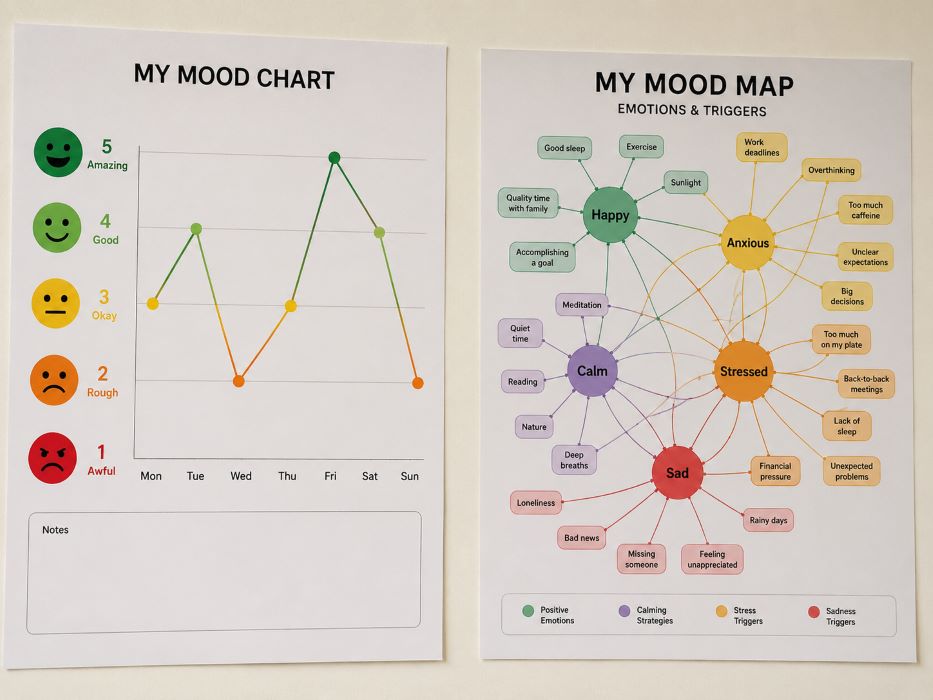
Most journaling and mental health apps ask you the same question every day: "How do you feel?" You tap an emoji, slide a scale, maybe add a note. After weeks of tracking, you have a colorful chart showing that Mondays are bad and Fridays are good. You already knew that. Mood tracking tells you what you feel. It never tells you why. The reason is that moods are outcomes, not causes. Tracking them is like measuring your body temperature every day without ever asking what is making you sick. Trigger mapping is the opposite approach — it identifies what causes the emotional reaction, pairs it with the specific emotion it produces, and tracks those pairs over time to reveal patterns invisible to mood tracking alone.
What Mood Tracking Actually Gives You
Mood tracking apps — Daylio, Bearable, Pixels, MoodFlow, and dozens of others — have become the default approach to emotional self-awareness. The premise is simple: log how you feel several times a day, and over time you will understand your emotional landscape.
Here is what you actually get after 30 days of mood tracking:
A graph showing your mood fluctuates. Some days are better, some are worse. There may be weekly cycles. There may be seasonal trends. You can see that you felt "anxious" 12 times this month and "calm" 8 times.
What you cannot see: why you felt anxious those 12 times. Whether the anxiety on March 3rd and the anxiety on March 17th share the same cause. Whether your Tuesday sadness and your Thursday anger are actually two expressions of the same underlying trigger. Whether the pattern is getting better or worse, and what is driving it.
Mood tracking gives you the what. It is completely silent on the why.
What Trigger Mapping Does Differently
Trigger mapping separates two things that mood tracking blends together: the emotion (what you feel) and the trigger (what caused it).
This distinction sounds obvious but almost no app makes it. When you log "anxious" in a mood tracker, the entry contains one data point: anxiety. When trigger mapping is applied, the same moment produces two data points: anxiety (the emotion) and unread message from manager (the trigger). These two data points are then paired and stored as a unit: anxiety ↔ work pressure.
Over time, these pairs accumulate and patterns emerge that mood tracking alone cannot reveal:
"Anger ↔ family conflict appeared 7 times in the last 30 days." "Anxiety ↔ work pressure appeared 5 times, but only on Mondays and Tuesdays." "Shame ↔ social comparison appeared 4 times, always after Instagram." "Sadness ↔ rejection appeared 3 times, connected to the same person."
Now you are not just seeing that you were angry 7 times. You are seeing that your anger has a specific, consistent address — family conflict. Your anxiety lives at work pressure, specifically early in the week. Your shame is triggered by social comparison, specifically on one platform.
This is the difference between a thermometer and a diagnosis.
Why This Matters for Actual Change
Knowing you feel anxious does not help you change anything. Knowing that your anxiety spikes specifically when you receive messages from authority figures — and that this pattern connects to a childhood dynamic where unpredictable communication from a parent meant danger — that changes everything. Because now you know what to work on.
Mood tracking keeps you at the symptom level. You manage symptoms: breathe when anxious, journal when sad, meditate when stressed. The symptoms return because the cause was never identified.
Trigger mapping takes you to the cause level. When you see that the same trigger category (work pressure, family conflict, rejection) keeps pairing with the same emotion across different situations, you have found the root. And roots can be addressed — in therapy, in journaling, in behavioral change.
This is not theoretical. Cognitive behavioral therapy has been built on exactly this principle for decades. The CBT thought record asks: what happened (trigger), what did you feel (emotion), what did you think (cognitive distortion). Three separate data points, not one. Mood tracking collapsed this into a single emoji. Trigger mapping restores the structure that makes CBT effective.
How Most Apps Handle Emotions vs How Seauton Does It
Here is a direct comparison of what happens when you journal about the same experience in different types of apps:
You write: "Had a terrible fight with my sister about the holidays. I feel furious but also kind of ashamed because I raised my voice."
Mood tracker (Daylio, Bearable, Pixels): Logs one mood — "bad" or "angry." Maybe you add a tag like "family." One data point. No connection between the anger and the shame. No identification of what triggered each emotion separately.
General AI journal (Rosebud, Mindsera, Reflection): Gives you a summary, maybe identifies that you experienced anger and shame. Might suggest a reflection prompt. Does not separate which trigger caused which emotion. Does not track the pair over time.
ChatGPT/Claude conversation: Responds empathetically, might help you process the situation, might identify the emotions. Forgets everything by next session. No pattern tracking. Optimized for making you feel heard, not for surfacing uncomfortable patterns.
Seauton: The AI reads your entry and separates the emotions from the triggers. Above your entry, it generates paired tags: (anger ↔ family conflict) and (shame ↔ loss of control). These pairs are stored and tracked across all your entries. After three weeks, you might see: "anger ↔ family conflict has appeared 6 times" and "shame ↔ loss of control has appeared 4 times, always in the same situations where anger appeared first." Now you are seeing something no mood tracker and no single therapy session could show: shame is not a separate problem. It is a consistent secondary response to your anger in family situations. That pattern has been running for weeks, maybe years, and you never saw it because no tool separated the data points.
The Pair System: How Emotion-Trigger Mapping Works
Seauton uses a closed set of approximately 14 core emotions (based on established psychological frameworks like Plutchik's emotion wheel) and approximately 18-20 trigger categories drawn from CBT and DBT research — categories like family conflict, work pressure, rejection, social comparison, loss, health anxiety, financial stress, identity threat, and boundary violation.
When you write or speak a journal entry, the AI identifies which emotions and which triggers are present and pairs them. One entry can generate multiple pairs. "I'm jealous about my colleague's promotion and angry that my boss didn't acknowledge my work" produces two pairs: (jealousy ↔ social comparison) and (anger ↔ work pressure).
These pairs are the fundamental unit of pattern tracking. Over weeks and months, Seauton shows you which pairs recur most frequently, which trigger categories activate multiple emotions, and which emotions consistently appear together in the same situations.
This is what Ray Kurzweil's Pattern Recognition Theory looks like applied to emotional self-awareness. The AI is not just reading your words — it is mapping the architecture of your emotional responses and showing you the blueprint.
What Trigger Mapping Reveals That Mood Tracking Cannot
After 30 days of trigger mapping, most people discover three things that mood tracking never shows:
Your emotional world is smaller than you think. Most people cycle through the same 3-4 emotion-trigger pairs for 80% of their entries. The chaos of daily emotions that feels overwhelming and unpredictable is actually a very small set of patterns on repeat.
Different situations share the same root. Your frustration at your partner, your anxiety at work, and your irritation at a stranger in traffic may all map to the same trigger category (boundary violation) paired with the same emotion (anger). Without trigger mapping, these feel like three separate problems. With it, they are one pattern wearing three costumes.
Secondary emotions mask primary ones. You think your problem is anxiety. Trigger mapping shows that anxiety consistently appears 10-20 minutes after anger, but only in family situations. The real pattern is suppressed anger converting to anxiety. No mood tracker can show you this because it only captures what you feel at the moment you log, not the sequence.
Mood Tracking Apps vs Trigger Mapping: Direct Comparison
What you learn after 30 days of mood tracking: Your average mood is 6.2/10. Mondays are worst. You felt anxious 12 times. You felt happy 8 times. Your mood improved slightly over the month.
What you learn after 30 days of trigger mapping: Your anxiety is driven by 2 specific trigger categories (work pressure and social comparison). Your anger is almost exclusively connected to family conflict. Shame appears as a secondary emotion after anger in family situations 4 out of 5 times. Your work anxiety spikes on Mondays and Tuesdays, correlating with weekly team meetings. Your happiest entries share a trigger category too — creative expression and deep conversation.
One gives you a weather report. The other gives you a map of your inner terrain.
Frequently Asked Questions
What is trigger mapping in journaling?
Trigger mapping is the practice of separating emotions from their causes (triggers), pairing them, and tracking those pairs over time. Instead of logging "I feel anxious" (one data point), trigger mapping captures "anxiety ↔ work pressure" (two paired data points). Over weeks, recurring pairs reveal which specific triggers drive which specific emotions — information mood tracking alone cannot provide.
Why doesn't mood tracking work for self-improvement?
Mood tracking captures what you feel but not why you feel it. After months of tracking, you know your average mood and which days are worst, but you do not know what drives the pattern. Without identifying the cause (trigger), you can only manage symptoms. Trigger mapping addresses this by pairing each emotion with its specific cause.
What is the difference between mood tracking and trigger mapping?
Mood tracking logs one data point per entry — the emotion. Trigger mapping logs two paired data points — the emotion and the trigger that caused it. Over time, mood tracking shows you a chart of emotional fluctuation. Trigger mapping shows you which specific life situations consistently produce which specific emotional responses.
Is there an app that separates emotions from triggers?
Seauton is an AI journaling app that automatically identifies emotions and triggers separately in your journal entries and pairs them. It tracks these pairs across weeks and months, revealing patterns like "anger ↔ family conflict appeared 6 times this month." No other major journaling app currently separates and pairs emotions with triggers in this way.
Can I use mood tracking and trigger mapping together?
Yes, but trigger mapping includes mood tracking by definition — every trigger map entry contains the emotion (mood) plus the cause (trigger). Trigger mapping is mood tracking with an added dimension. Using both is redundant unless you want the simplicity of emoji-based logging alongside the depth of paired analysis.
How does Seauton detect emotions and triggers in my writing?
Seauton uses AI to analyze your journal entry (text or voice) and identify which emotions and which trigger categories are present. It draws from a set of approximately 14 core emotions and 18-20 trigger categories based on CBT and DBT research. The AI pairs each emotion with its corresponding trigger and stores the pair for long-term pattern tracking across all your entries.
How long does trigger mapping take to show patterns?
Most people see their first recurring emotion-trigger pairs within 1-2 weeks. Deeper patterns — like discovering that shame consistently appears as a secondary emotion after anger in family situations — typically emerge after 3-4 weeks of daily entries.
Seauton vs Daylio for emotional tracking?
Daylio is a mood tracker — you tap an emoji and optionally add activities. It shows you mood trends over time. Seauton is a trigger mapper — you write or speak freely, and the AI separates your emotions from their causes, pairs them, and tracks the pairs over months. Daylio tells you how often you felt anxious. Seauton tells you why, and what pattern your anxiety has been following across different life situations.
Seauton vs Bearable for mental health tracking?
Bearable tracks symptoms, moods, and health factors with detailed logging. Seauton tracks the psychological architecture beneath your moods — which triggers drive which emotions, which patterns repeat, and how secondary emotions mask primary ones. Bearable is excellent for health correlation (sleep, diet, exercise vs mood). Seauton is built for psychological pattern recognition.